Showing posts with label iNaturalistNZ. Show all posts

Tuesday, 26 May 2020

Autumn Leaf Study in New Zealand - leaf art, leaf scavenger hunts and more

Autumn around the world is a time that lends itself to investigate leaves, through making leaf art, going on a leaf scavenger hunt and learning about trees and their leaves.

Yet in New Zealand where almost every native tree is evergreen, the emphasis on trees changing colour and losing they leaves could seem to favour introduced trees over native trees. Here are some activities and ideas for studying native tree leaves in New Zealand. Autumn is still a good time to study leaves as it is interesting to compare deciduous and evergreen trees.

ACTIVITY: Go on a leaf hunt to find different colour leaves and identify whether trees are evergreen or deciduous. 

Deciduous trees - those that lose their leaves in autumn - do so to survive a cold winter, saving energy and getting rid of leaves that might pick up diseases. The trees draw back into their branches and trunk all the goodness that was in the leaves, such as water, nutrients and the green substance chlorophyll. So the leaves change colour, dry out and fall.

Tuesday, 17 December 2019

At the Beach in New Zealand - explore and discover what lives there

"At the Beach" includes a lift-out identification card
"At the Beach: explore and discover the New Zealand seashore" was published in 2012 and is now a New Zealand Bestseller. The book comes with a lift-out (double-sided) identification card in the inside back cover. This is very popular, as it can be taken to the beach separately from the book. Unfortunately it can also get easily lost! I've noticed school and library copies often have it removed too. so Ned and I thought it should be available as PDF for schools and libraries to print out. 

Thursday, 12 December 2019

Penguin Walks - kororā count

On a couple of spring days every year, volunteers from Kāpiti Biodiversity Project get up very early. It's still dark outside as they make their way to a meeting point at Paekakariki Beach. It's chilly and they are rugged up in coats and hats. As the sky begins to brighten, they make their way slowly along the beach scanning the sand for footprints.
A trail of footprints being examined by volunteers
The tide is out, the sand has been washed clean of yesterday's footprints, so any new prints on the beach have been made since the last high tide. The volunteers are looking for prints like these:

Monday, 12 March 2018

A Coastal Walk - animals that I see in Pukerua Bay

After writing about the plants of my coastal pathway in my last blogpost, Cyclone Gita blew in. Extraordinarily high seas washed away much of the pathway and deposited massive piles of driftwood on what was left. Plants on the sea side of the path have mostly died, but not all.  I hope they are resilient.
Driftwood covers the path
Taking this path, very occasionally right around to Plimmerton, but usually to the Pukerua Bay Scientific Reserve and back, I've had the privilege of seeing many different animals, some unexpected.
Fur seals make occasional appearances along the coast
It's only recently that I've attempted to photograph them. More often than not I only have my phone camera handy. Photos are a good way to convey an animals features or behaviour to others. We get instant recognition, responding with an "Ah yes that's what I saw on my beach" or "how amazing who knew gulls would do that?"

Tuesday, 6 February 2018

A Coastal Walk - naming the plants

Volunteer work takes me for a walk along the coast several mornings a month in summer.  Walking the same path, day after day, isn't dull or a chore. 
The path along the coast, white-faced heron ahead
Each day, I see something different, depending perhaps on the weather or the tide, or I see something differently. Sometimes there are big changes: a storm leaves soft-bodied jelly fish and bright orange sponges stranded on the beach and covers the path with driftwood. 

Wednesday, 8 November 2017

Experiencing Nature with Kids - their way

It was all about being hands-on at the Koraunui Bioblitz this week. Schools in Stokes Valley took part in an amazing day of exploration on organised by Dianne Christenson of Koraunui School and supported by scientists and experts. Did I have some pre-conceived notions of a Bioblitz? Maybe, but I agreed with a fellow expert that this one should be led by the children's interests and observations.

My first eager group had bounce in their step as we headed along a small path among some new plantings at Horoeka Scenic Reserve.

Sunday, 27 August 2017

Getting Past the 'ick' Factor: for a Predator Free New Zealand

There's a momentum building across the country, as community after community sets up 'Predator Free' or 'Pest Free' groups. Last November, Predator Free Pukerua Bay kicked off with a well attended meeting in the local hall.  We weren't starting from scratch as in the Pukerua Bay scientific Reserve volunteers were trapping for weasels, stoats, and rats, and around the reserves Greater Wellington Regional Council has bait stations. Also a few locals were already trapping on their sections. But this was just a drop in the ocean compared to what we could do together as a community.

Why we trap - to protect our native wildlife


Monday, 1 May 2017

Tricked by a Seal - what counts as normal behaviour?

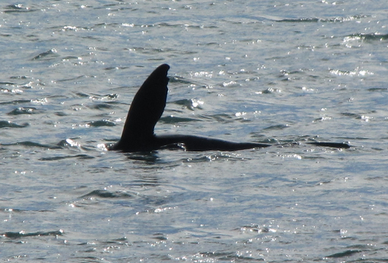
Last weekend at the beach, we saw a fur seal (kekeno) holding one flipper in the air for a long, long time. It's not surprising that some people thought what they were seeing was a dolphin fin, but I recognised this seal pose from a previous encounter.

Seals have tricked me before with their one-flipper pose. A month ago, I saw a seal hold this one-flipper pose for much longer than ten minutes. I began to worry that it was injured. Only after I had called the DOC Hot Line and was speaking to someone there, did it roll over and clap its flippers together as if pleased by the joke.
Seal - thermal regulating


I thought that it must have been having a rest, but a friend explained that what the seal is doing is called thermal regulating. Holding a flipper out of the water helps it either cool down or warm up, depending on the sun and the wind.

Saturday, 25 March 2017

Endangered Reef Herons - reporting sightings

Described as Nationally Endangered, there are only 300-500 reef herons left in New Zealand. I'm lucky to live in of the few places that they visit. It's a privilege to be able to watch them down among the rock pools and in the shallows.
Reef Heron showing breeding plumes on its back
Scientists are interested in sightings of this bird and you can report these through iNaturalistNZ or Project Hot Spot (although the focus of the latter is Taranaki). Before you send in a report - here's how to tell the difference between the endangered reef heron and the common white-faced heron. Both are called matuku moana in Māori.

How do you tell the difference between a white-faced heron and a reef heron?

Monday, 17 October 2016

Weeds or Wild Flowers - What do we See?

One person's weed is another person's garden flower. I've seen the delight in the eye of visitors from Europe when they saw what they took to be garden flowers such as white Arum lilies (Zantedeschia) or blue Agapanthus flowering by our roadsides.

Arum Lilies spreading alongside a pathway


It's not just visitors who see them as delightful wild flowers or as garden plants, lots of locals do too. But how we see them doesn't alter the fact that these and many other imported plants grow, and spread, like wild fire in New Zealand's climate. They encroach on dunes, on bush remnants, on stream banks pushing out native plants and reducing our,  and therefore the world's, biodiversity.


Thursday, 23 June 2016

Garden Bird Survey and Volunteer Week - Citizen Science at its best

Days, Weeks or Months that highlight different causes or ideas pander to our short attention spans, but if we only volunteer in volunteer week, not much would get done around the country! I'd like to think Volunteer Week gets people started, selecting a cause to volunteer with. There are so many deserving causes, there really is something for everyone, whether it is helping make breakfasts in schools , delivery library books to the housebound, patrolling a dangerous beach as a lifeguard or building rat traps.
Rat traps for gardens and parks in Paekakariki 


Thursday, 25 June 2015

A Rainbow of Fungi on a Mid-year Walk


This year our fungi hunt was delayed to June. An autumn without rain meant the usual outburst of colour from the ground and trees didn't show until nearly winter.

Now that its wet and cold enough, those magical fungi have appeared. Some are the fairy kind of magic - charming rings and fairy fingers, bright rainbow of pouches and waxgills, the perfect blue toadstool.
purple pouch fungi, wax gill fungi

Monday, 22 December 2014

The best of the season - a year of nature blogging

As the summer Christmas/New Year break approaches here's a look back on the Best of 2014 blog posts.
Pohutukawa - New Zealand Christmas tree


BEST OF 2014 BLOG POSTS

Thursday, 23 October 2014

Forest and Bird Walks in Wellington - from my journal

It's spring and heading into tramping season. Thanks to the longer days and warmer weather (and the fact that I'm between books) I've been able to go out with Forest and Bird on a lot of day walks. Here's a sample from my nature journal of what I've observed.


Puriri moth
WEDNESDAY 8th - KARAPOTI
Tramping out from seeing  the Giant Rata, a puriri moth was found by a fellow tramper on the pathway. He picked it up to move it to safety.  This is the first time I've seen a live puriri moth so I was pretty excited by this find. What a gorgeous mossy green and what big eyes it has!


Thursday, 24 July 2014

Watching Nature with NatureWatchNZ

UPDATE 25.6.18 to this blog post: Nature Watch NZ is now iNaturalistNZ, you can see all my observations at https://inaturalist.nz/observations/candler

You may have noticed that a 'widget' has appeared below my blogposts, headed Nature Watch NZ.


Explore and Discover Nature is all about observing nature: quirky events like the By the Wind Sailor beach invasion last year or the Sea Foam after the Storm ; through seasonal observations such as Winter Walks in the Bush, to places to go and things to do when out and about.

By the Wind Sailors

Thursday, 19 June 2014

Winter Walks in the Bush - flowers and fungi

On a cold, wet winter's day sometimes the last thing I want to do is go outside. But I know that if I put on my raincoat, beanie, and boots and head into the bush, I'll find all sorts of winter treasures. The tall trees give a bit of protection from the rain, but I know if I lean against one or give it a bit of a shake, it'll drip raindrops all over me!

In winter, look closely at the ground and you might see some real surprises, like these tiny greenhood orchids which flower in winter - yes those are the flowers. They were gathered together on a bank by the path, and we nearly walked right past them.
Greenhood Orchids - Diplodium alobulum

Wednesday, 23 October 2013

By-the-Wind-Sailors by the Thousands

A few days ago at high tide we found these transparent 'things' on the beach:

We wondered what they were. The next day at low tide they were revealed as the framework of By the Wind Sailors, scientific name Velella velella.