Showing posts with label Department of Conservation. Show all posts

Monday, 19 June 2017

What Bird is That? identifying native forest birds

Forest Birds ID card from "In the Bush" - now free to download
Interested in New Zealand's native birds and want to be able to identify them? Ten or so years ago I'd be out in the forest not sure what I was hearing or seeing. Here's some of the steps that I took to improving my knowledge of New Zealand birds.

Set yourself a bird-watching challenge: for example, take part in the New Zealand Garden Bird Survey on this week from 24 June to 2 July.  Gardens are a good place to start because often birds are easier to see in a garden and you can learn bird-watching techniques (see tips below) that will help you when you are out in the forest, beach or wetland. The Top 10 birds in gardens in 2016 were:

Monday, 1 May 2017

Tricked by a Seal - what counts as normal behaviour?

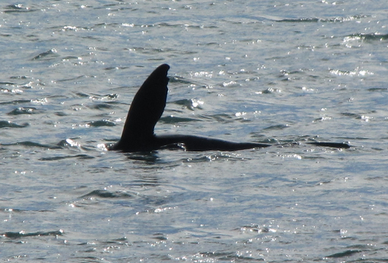
Last weekend at the beach, we saw a fur seal (kekeno) holding one flipper in the air for a long, long time. It's not surprising that some people thought what they were seeing was a dolphin fin, but I recognised this seal pose from a previous encounter.

Seals have tricked me before with their one-flipper pose. A month ago, I saw a seal hold this one-flipper pose for much longer than ten minutes. I began to worry that it was injured. Only after I had called the DOC Hot Line and was speaking to someone there, did it roll over and clap its flippers together as if pleased by the joke.
Seal - thermal regulating


I thought that it must have been having a rest, but a friend explained that what the seal is doing is called thermal regulating. Holding a flipper out of the water helps it either cool down or warm up, depending on the sun and the wind.

Monday, 17 October 2016

Weeds or Wild Flowers - What do we See?

One person's weed is another person's garden flower. I've seen the delight in the eye of visitors from Europe when they saw what they took to be garden flowers such as white Arum lilies (Zantedeschia) or blue Agapanthus flowering by our roadsides.

Arum Lilies spreading alongside a pathway


It's not just visitors who see them as delightful wild flowers or as garden plants, lots of locals do too. But how we see them doesn't alter the fact that these and many other imported plants grow, and spread, like wild fire in New Zealand's climate. They encroach on dunes, on bush remnants, on stream banks pushing out native plants and reducing our,  and therefore the world's, biodiversity.


Wednesday, 15 June 2016

Northern Giant Petrel - Beach Rescue and Ocean Release


Some days you just don't know what you'll find at the beach.


One stormy Sunday afternoon, we were walking along and saw a couple of kids in the waves. 'Crazy kids' I thought since it is winter and, although the waves looked exciting, the kids looked cold. Then we realised that they were trying to rescue a large black bird that was being bashed about by the waves.

Monday, 18 April 2016

The Pitfalls of Monitoring Skinks- our elusive native lizards

Picture this, early morning in summer and a couple of people crouched by the coastal path, wearing knee pads, peering into holes in the ground. No wonder the local dog walkers were suspicious! However they soon got to know who we were and what we were up to. The holes in the ground are pitfall traps of lizards, and we are a group of volunteers working with a lizard scientist (herpetologist) to monitor skinks in our local reserve.


Skink in a pitfall trap (other items removed)


Monday, 4 April 2016

Return to Blue Lake - More Blue Ducks

Last month I returned to Blue Lake. I'd visited the lake a year ago and blogged about it in Trouble In Paradise after witnessing an attempted attack on an endangered blue duck or whio by a rat. I'd told my tramping companions about the blue ducks we'd sighted last time, so we had high expectations of seeing some beautiful whio again - and we were hoping not to have a repeat of the rat incident!

Mountains and clouds reflected in Blue Lake

Tuesday, 26 January 2016

Sardine Smoothies Again! Feeding seabirds on Mana Island

Last year I blogged about my volunteer week on Mana Island helping with the Fairy Prion translocation. You'd think the long days, hot sun, and the smell of sardines might have put me off - but when the call came out for volunteers for the second year of this project I couldn't resist the opportunity to put my name forward. I convinced myself that it was a chance to use the skills I'd learned the year before, that the work really hadn't been that hard, the smell of sardines not too bad, and that the sun couldn't surely be as hot again - not in a Wellington January.

Holding one of the new arrivals

Wednesday, 28 October 2015

Geckos in the Spotlight: volunteering on Mana Island

A trip to Mana Island, which is free from mammal predators and pests, is enough to show how incredible the lizard life of ancient New Zealand would have been. Mana is not only free from rats, cats, hedgehogs and stoats; there are also no mice here.

Monday, 25 May 2015

Seeing Plants with New Eyes - learning the language of plants

Gillian Candler reviews the NMIT Plant Identification course

An informative guided walk at Otari/Wilton's Bush last year spurred me on to join the local Botanical Society. I’m a children’s author so sometimes take a childlike view of things, I get excited by Hen and Chicken’s Ferns
Hen and Chickens Fern
and Puriri moths in Putaputaweta trees, I love the statuesque Wheki-ponga that look like people wearing cloaks and I delight at discovering hanging orchids.  But listening to members of the Botanical Society I often feel like a stranger in a foreign land who can only say ‘hello’ and ‘goodbye’ in that language, a good conversation being out of the question.

Saturday, 25 April 2015

Tips for Reading With Children - Under the Ocean

To help children, parents and educators get the most out of my books, I've written down ideas for reading each book, activities and further places to get good information. These have been on the publisher's website, but a recent revamp means these pages are temporarily inaccessible. So for now I'm putting these ideas on the blog.

Tips for Reading Non-Fiction With Children

Sunday, 12 April 2015

Visiting New Zealand's Forest Giants in Waipoua Forest

White skeletons stand out starkly among the green of the Waipoua Forest - they are dead kauri trees. As if the tree-felling, milling, gum collecting and land clearing weren't enough to put this giant tree in danger, sadly they are now succumbing to a silent fungus-like disease called kauri die-back.
White branches indicate kauri die-back

A long overdue visit to the far North, meant that it was close to 20 years since I last visited the forest giants Tane Mahuta and Te Matua Ngahere as well as the Four Sisters. Because kauri only grow in the north of the North Island they seemed exotic to us, rare beings, even then there were only a few giant specimens standing. Still the forest appeared lush and the kauri mighty.

Today the giant Tane Mahuta (52 metres high) and Te Matua Ngahere are still impressive.

Thursday, 12 March 2015

Beautiful Blue Ducks at Blue Lake - but there is trouble in paradise

The poster in the hut on the Travers-Sabine trail asked for sightings of rare birds and animals - weka, blue duck (Maori name whio, pronounced 'fee-o'), kea, kaka, black-eyed gecko, rock wren. Being observant trampers, it was with high hopes we set off to record sightings. The rushing mountain streams seemed a likely place for whio.  After three days and not a whio whistle, we came to Blue Lake or Rotomairewhenua (land of peaceful waters), surely the highlight of any tramp in this area.

Blue Lake - Rotomairewhenua


Thursday, 29 January 2015

Saturday, 1 November 2014

Celebrating Conservation Week

Posters from Conservation Week 1993
A wonderful way to start Conservation Week - a mystery parcel arrived from a friend and in it were these posters from Conservation Week 1993. They've been on classroom walls and in children's bedrooms and now they've come to rest in my study.


Saturday, 20 September 2014

Counting Birds - New Zealand's 10 most common forest birds

I've been subjected to some friendly teasing from friends and family, who find it amusing that I just spent 2 days on a bird counting course. "How hard can it be?" they laugh, counting off 1 - 2 - 3 on their fingers.
 One tui in a kowhai tree

Friday, 22 August 2014

In Praise of DOC Huts

We have a unique system of public backcountry huts in New Zealand. From poky, smoky huts etched with history through to Great Walk palaces with solar lighting, these huts provide much needed shelter on our tramping tracks. Often a convenient day's walk apart, most provide the basics of bunks, benches, rainwater tanks and a tap, with an outdoor toilet at a pong-free distance.

There's nothing quite like the sight of a hut in the distance after a tough day on the trail. Glimpse it in the distance through the bush or across the bay and suddenly your pack feels lighter, the rain less persistent, and hunger more bearable.

But best of all is the view from the hut, having been on the move all day, you can now sit and enjoy the view out to sea, up the river, or deep into the bush interior.

The huts on the North-West Circuit of Stewart Island, are all in inspired locations. Each hut we came to had its own delightful setting. Thanks DOC!

Thursday, 5 June 2014

Ulva Island - New Zealand island sanctuary

Well worth a visit, Ulva Island/Te Wharawhara deserves to be better known.

Ulva Island

Being close to main centres: Tiritiri Matangi and Kapiti Island get more publicity. But Ulva Island has some wonderful points of difference. Situated close to Oban on Stewart Island, here you might see the Stewart Island Robin (Toutouwai), South Island Saddleback (Tieke), Brown Creeper (Pipipi), and Yellowhead (Mohua), none of which can be seen on the North Island sanctuaries. If you are lucky you might even see a Stewart Island kiwi (Tokoeka).

Saturday, 19 April 2014

World Heritage Day - protecting our natural heritage

What better way to spend World Heritage Day, than getting out and protecting our natural heritage. It just so happened that the stormy weather cleared and Friends of Mana Island volunteers were able to get out and clear the pest traps along the nearby mainland coast. Volunteers clear these DOC traps regularly, each time they are cleared the trap is set again and ready to catch another pest.


Saturday, 15 March 2014

Great White Scare - Butterflies in the Garden

Usually when we hear Great White, we think of the Great White Shark which has a fearsome reputation. Recently a new Great White has appeared on land, and while it might look like a cute butterfly it has a fearsome reputation too!


Gardeners think of the Cabbage Butterfly (or Small White) as a pest, it seems that the Great White is even more destructive and is a danger to native plants as well as to crops.

It is their caterpillar that is destructive, eating up large amounts of leaves and making it hard for plants to grow. Each type of butterfly favours a different plant, and both the white butterflies like plants in the brassica family. This includes cabbages, broccoli and nasturtiums.


Sunday, 29 December 2013

Day trips from Wellington - The Pinnacles

Summer is a good time to get out and about with children. This day trip is a long drive from Wellington but worth it for the adventure that it provides.

The Pinnacles are in Putangirua Scenic Reserve, the DOC website tells you how to get there and a bit about the Pinnacles.