Showing posts with label native plants. Show all posts

Tuesday, 26 May 2020

Autumn Leaf Study in New Zealand - leaf art, leaf scavenger hunts and more

Autumn around the world is a time that lends itself to investigate leaves, through making leaf art, going on a leaf scavenger hunt and learning about trees and their leaves.

Yet in New Zealand where almost every native tree is evergreen, the emphasis on trees changing colour and losing they leaves could seem to favour introduced trees over native trees. Here are some activities and ideas for studying native tree leaves in New Zealand. Autumn is still a good time to study leaves as it is interesting to compare deciduous and evergreen trees.

ACTIVITY: Go on a leaf hunt to find different colour leaves and identify whether trees are evergreen or deciduous. 

Deciduous trees - those that lose their leaves in autumn - do so to survive a cold winter, saving energy and getting rid of leaves that might pick up diseases. The trees draw back into their branches and trunk all the goodness that was in the leaves, such as water, nutrients and the green substance chlorophyll. So the leaves change colour, dry out and fall.

Wednesday, 10 July 2019

Native Trees and Plants of New Zealand Brought Vividly to Life

The act of identifying and naming plants changes the way we see the bush. No longer is it a tangle of different greens, a confusing mass of different shape leaves. Bark, flowers, berries, leaves, all provide clues about the trees in the canopy above or help us distinguish the different plants in the understorey.  Once we can tell them apart the bush, wetlands, coast all begin to look very different to our eyes.

But learning about native plants even for those regularly in the bush can be a slow process. Among my Forest and Bird tramping group, there are repeated discussions as we remind ourselves about the differences between mataī and miro; mānuka and kānuka; horopito and toropapa. (Perhaps we can be forgiven for struggling to tell the latter two apart, as page 30 of The Meaning of Trees tells me this is likely to be down to plant mimicry.) 

In the end, it is rich descriptions and stories that help us remember the differences and characteristics. Toetoe has drooping flowers, those of pampas are erect and spear-like. Rangiora is the bushman’s friend, its thick leaves were handy for toilet paper or writing notes on. The blood red colour below the flaking bark of mataī was seen in some traditions as representing the blood of Tunaroa, the eel god slain by Māui. 

The Meaning of Trees: the history and uses of New Zealand’s native plants by Robert Vennell is a treasure trove of such rich descriptions and stories of our native trees, shrubs and and other plants such as vines, flax, bracken and even bull kelp. The book rewards repeated reading, and dipping into, as each time something new stands out, a whakataukī, a legend, or maybe where it got its name.

Tuesday, 6 February 2018

A Coastal Walk - naming the plants

Volunteer work takes me for a walk along the coast several mornings a month in summer.  Walking the same path, day after day, isn't dull or a chore. 
The path along the coast, white-faced heron ahead
Each day, I see something different, depending perhaps on the weather or the tide, or I see something differently. Sometimes there are big changes: a storm leaves soft-bodied jelly fish and bright orange sponges stranded on the beach and covers the path with driftwood. 

Thursday, 2 February 2017

Return to Rakiura - Stewart Island


Sunrise from Fred's Camp
Rakiura means 'glowing skies' and the soft pastel colours in the sky around Stewart Island on my recent visit showed again and again the appropriateness of this Maori place name. Views like this sunrise above were nearly enough to turn this writer to taking up water-colour painting!

Monday, 17 October 2016

Weeds or Wild Flowers - What do we See?

One person's weed is another person's garden flower. I've seen the delight in the eye of visitors from Europe when they saw what they took to be garden flowers such as white Arum lilies (Zantedeschia) or blue Agapanthus flowering by our roadsides.

Arum Lilies spreading alongside a pathway


It's not just visitors who see them as delightful wild flowers or as garden plants, lots of locals do too. But how we see them doesn't alter the fact that these and many other imported plants grow, and spread, like wild fire in New Zealand's climate. They encroach on dunes, on bush remnants, on stream banks pushing out native plants and reducing our,  and therefore the world's, biodiversity.


Sunday, 29 November 2015

Signs of Spring and Summer - and the first cicada

The white star-shaped flowers of the clematis vine hung across the green trees across the valley, were the very first signs of spring.  
Native clematis

Monday, 31 August 2015

The Importance of Trees

On the Kapakapanui track some joker has put up a Give Way sign where the track diverges, yet I've never met another party here to give way to.
 I like to think of it as a reminder that we need trees and had better give way to them!
Give way to ... Trees

Saturday, 8 August 2015

Behind the Scenes - Nature at Te Papa

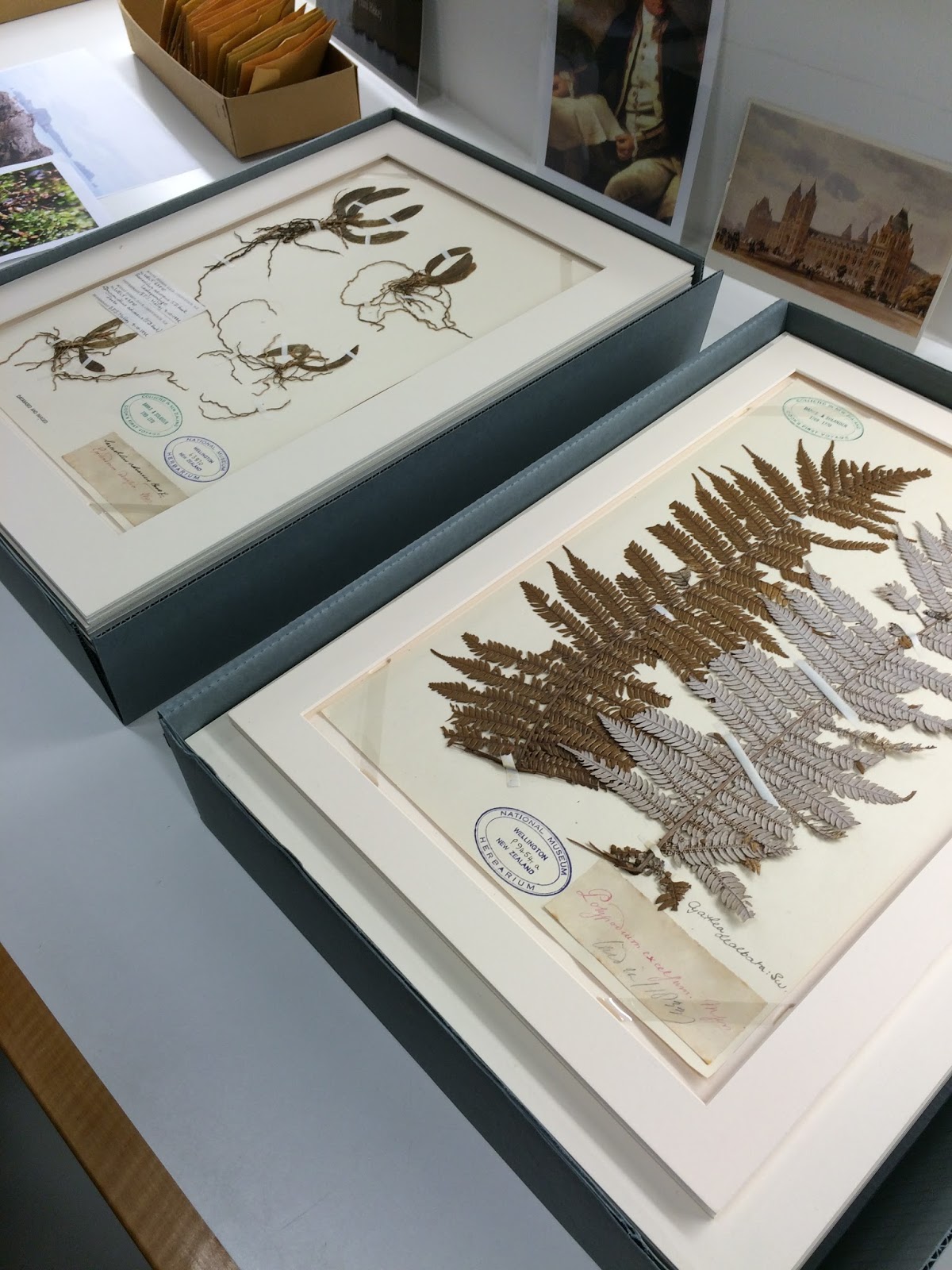
Usually I'm out and about exploring nature - outside. But recently Wellington's 150th Capital Anniversary provided a special opportunity to explore nature indoors. An open day at the museum - Te Papa Tongarewa - was a unique chance to see some of the treasures stored there.

The day started with a guided behind-the-scenes tour of the Botany collection. Te Papa's curators had carefully selected some treasures to show us, from plants collected by Solander on Cook's 1st voyage 1768-1771
Solander's collection orchid and tree fern

to the now extinct Cook's scurvy plant

Monday, 25 May 2015

Seeing Plants with New Eyes - learning the language of plants

Gillian Candler reviews the NMIT Plant Identification course

An informative guided walk at Otari/Wilton's Bush last year spurred me on to join the local Botanical Society. I’m a children’s author so sometimes take a childlike view of things, I get excited by Hen and Chicken’s Ferns
Hen and Chickens Fern
and Puriri moths in Putaputaweta trees, I love the statuesque Wheki-ponga that look like people wearing cloaks and I delight at discovering hanging orchids.  But listening to members of the Botanical Society I often feel like a stranger in a foreign land who can only say ‘hello’ and ‘goodbye’ in that language, a good conversation being out of the question.

Sunday, 12 April 2015

Visiting New Zealand's Forest Giants in Waipoua Forest

White skeletons stand out starkly among the green of the Waipoua Forest - they are dead kauri trees. As if the tree-felling, milling, gum collecting and land clearing weren't enough to put this giant tree in danger, sadly they are now succumbing to a silent fungus-like disease called kauri die-back.
White branches indicate kauri die-back

A long overdue visit to the far North, meant that it was close to 20 years since I last visited the forest giants Tane Mahuta and Te Matua Ngahere as well as the Four Sisters. Because kauri only grow in the north of the North Island they seemed exotic to us, rare beings, even then there were only a few giant specimens standing. Still the forest appeared lush and the kauri mighty.

Today the giant Tane Mahuta (52 metres high) and Te Matua Ngahere are still impressive.

Thursday, 23 October 2014

Forest and Bird Walks in Wellington - from my journal

It's spring and heading into tramping season. Thanks to the longer days and warmer weather (and the fact that I'm between books) I've been able to go out with Forest and Bird on a lot of day walks. Here's a sample from my nature journal of what I've observed.


Puriri moth
WEDNESDAY 8th - KARAPOTI
Tramping out from seeing  the Giant Rata, a puriri moth was found by a fellow tramper on the pathway. He picked it up to move it to safety.  This is the first time I've seen a live puriri moth so I was pretty excited by this find. What a gorgeous mossy green and what big eyes it has!


Monday, 13 October 2014

Pilgrimage to a Tree - the largest known Northern Rata

In dense bush north of Wellington stands the truly awesome giant Karapoti Rata.

Forest and Bird trampers and the Karapoti Rata
Thought to be over 1000 years old, it is 39 metres high and has a girth or circumference of over 15m. To read about who measured it, see The New Zealand Tree Register. The register tells you the GPS location of the tree. But it's one thing to know the location, it's quite another to find the tree in the forest.

Monday, 1 September 2014

First Day of Spring - Tui and native flowers


The traditional first day of spring is cool, calm and sunny. We've had many winter days with settled weather, so it's been easy to get out and about. There have been signs of spring everywhere. The noisiest are the tui, usually solitary birds, they're gathering together, chasing, swooping and flying around the bay from tree to tree.
Five Tui silhouetted in a tree

Friday, 18 July 2014

Mangaone Walkway - one of the best local bushwalks for family and friends

A short drive from Waikanae, tucked away behind the hills, at the end of the winding Managone South Road is one of the best easy bushwalks on the Kapiti Coast.

Features of this walk that make it a good one to introduce overseas visitors, non-tramping friends, children and grandchildren to the delights of bushwalks.

It starts with a Swing Bridge.

Monday, 30 June 2014

Nature Walks at Zealandia - edible plants


The Zealandia walking group sets out to explore Zealandia every second Monday. Recently we've been lucky enough to have some experts teach us more about the plants in Zealandia.

Thursday, 19 June 2014

Winter Walks in the Bush - flowers and fungi

On a cold, wet winter's day sometimes the last thing I want to do is go outside. But I know that if I put on my raincoat, beanie, and boots and head into the bush, I'll find all sorts of winter treasures. The tall trees give a bit of protection from the rain, but I know if I lean against one or give it a bit of a shake, it'll drip raindrops all over me!

In winter, look closely at the ground and you might see some real surprises, like these tiny greenhood orchids which flower in winter - yes those are the flowers. They were gathered together on a bank by the path, and we nearly walked right past them.
Greenhood Orchids - Diplodium alobulum

Saturday, 31 May 2014

Nature Walks at Otari Wilton's Bush

Otari-Wilton's Bush is a Wellington treasure. Not only has New Zealand's native bush been preserved here, but special gardens hold a collection of plant treasures from around New Zealand. I've always thought of this as a great place to bring children to romp around in the bush, it's wild but not so wild that you could get horribly lost. Last year when I came here with some young cousins, we took the nature trail and while they enjoyed running ahead, we had them stop at each of the numbers to do some quick observation before running on helter-skelter down the track.

On Wednesday I came with quite a different group, members of the Forest and Bird Wellington Regional Tramping group. While the group is normally keen to move at a good pace they don't usually run helter-skelter! This time though we were all prepared to go very slowly, stopping and starting as volunteer guides from the Otari-Wilton's Bush Trust led us through the plant collections, showing us things to look for to help us with plant identification.

Thursday, 20 February 2014

New App to Help Identify Native Flora

In the park, on a school trip or out tramping, here's a new tool to identify common native trees. 

With Flora Finder you take a photo of a leaf you're interested in, answer a few simple questions about the leaf to narrow down the selection and then see what matches come up. Flora Finder uses shape recognition technology to match your leaf with one (or more) of the common native trees in the database. There are 87 species in the database with more to come in the future.

It's encouraging to see a New Zealand App about our native flora that takes an interactive approach and makes full use of the iPhone or iPad capabilities of photography, mapping and feedback to the creators. Users can save their identified trees on a map for future reference. You can also use the App to email photos of leaves that weren't able to be identified to Otago University, and apparently this feature is proving popular.

Thursday, 22 August 2013

Winter Flowers in the Bush

In the last week our native clematis has been starting to make itself seen. Patches of frothy white blooms are appearing on the bush canopy. They'll grace the canopy for a few months before the flowers die and turn into fluffy seed heads and the leaves merge back into the green canopy.
Department of Conservation have published a resource about clematis in the Wellington region that can help you tell one native clematis from another.
Clematis paniculata

Friday, 9 August 2013

Supermarket Tree on Tiritiri Matangi

On my trip to Tiritiri Matangi I was most impressed by the knowledgeable volunteer guides who took small groups around the pathways in search of birds. Our guide carried some of the stunning photographs he'd taken, to show us characteristics of birds and plants. He also knew all the good places to stop and look.
One place we stopped was by what he called the 'supermarket tree',it was easy to see how it got its name. This big Puriri tree was full of tui, bellbirds, stitch birds, white heads and kereru. On the ground below were robins scratching around. The big attraction were the Puriri flowers - the nectar must be very tasty and full of energy.